

Theory · storage
Storing seed means postponing germination.
A commercial seed lot waits from one harvest to the next. A seed bank keeps a species for decades. In both cases the question is the same: after storage, does the seed still germinate? This page shows what decides the answer and how it is checked, with the work of the orchid research group (GPEOrq) and the seed research group (GPSEM) on orchids and forage grasses.
Understand · visual
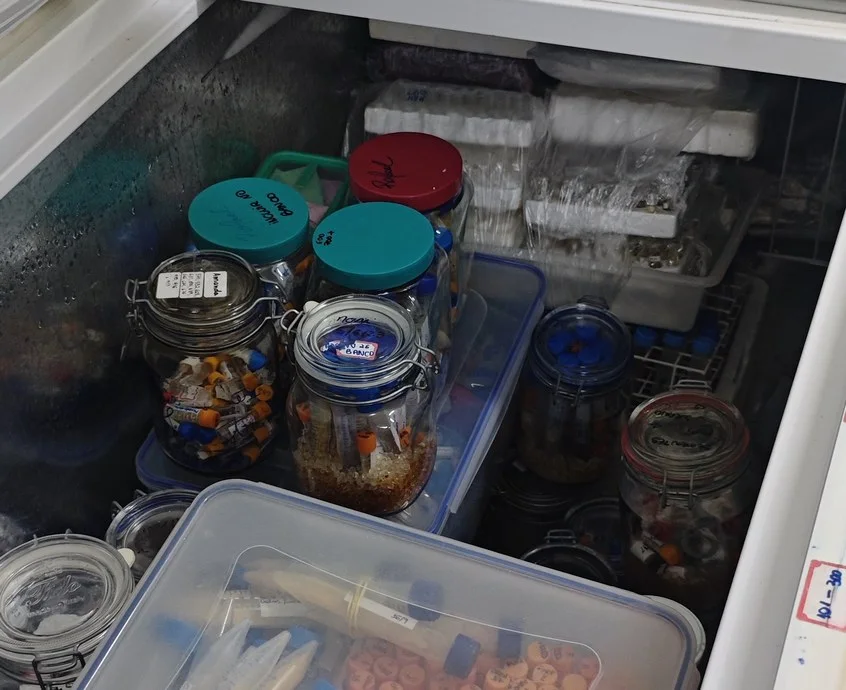
01 · Why store seeds
From the harvested seed lot to the seed bank
In production, seed harvested in one year goes to the field the next year, and the seed lot still has to germinate when it gets there. In conservation, the time frame is different: the seed bank keeps the diversity of a species for when it is needed, sometimes decades later.
For orchids, the seed bank is the simplest and cheapest way. A capsule holds thousands of seeds, and a small vial keeps a lot of variability in a small space [1]. GPEOrq maintains an orchid seed bank and takes part in the OSSSU network of orchid seed banks, with Kew and the Singapore Botanic Gardens.
For a long time it was said that orchid seed is short-lived in storage. The group's work shows that it depends on the species and on how it is stored, and that many hold up well in a conventional seed bank [6].
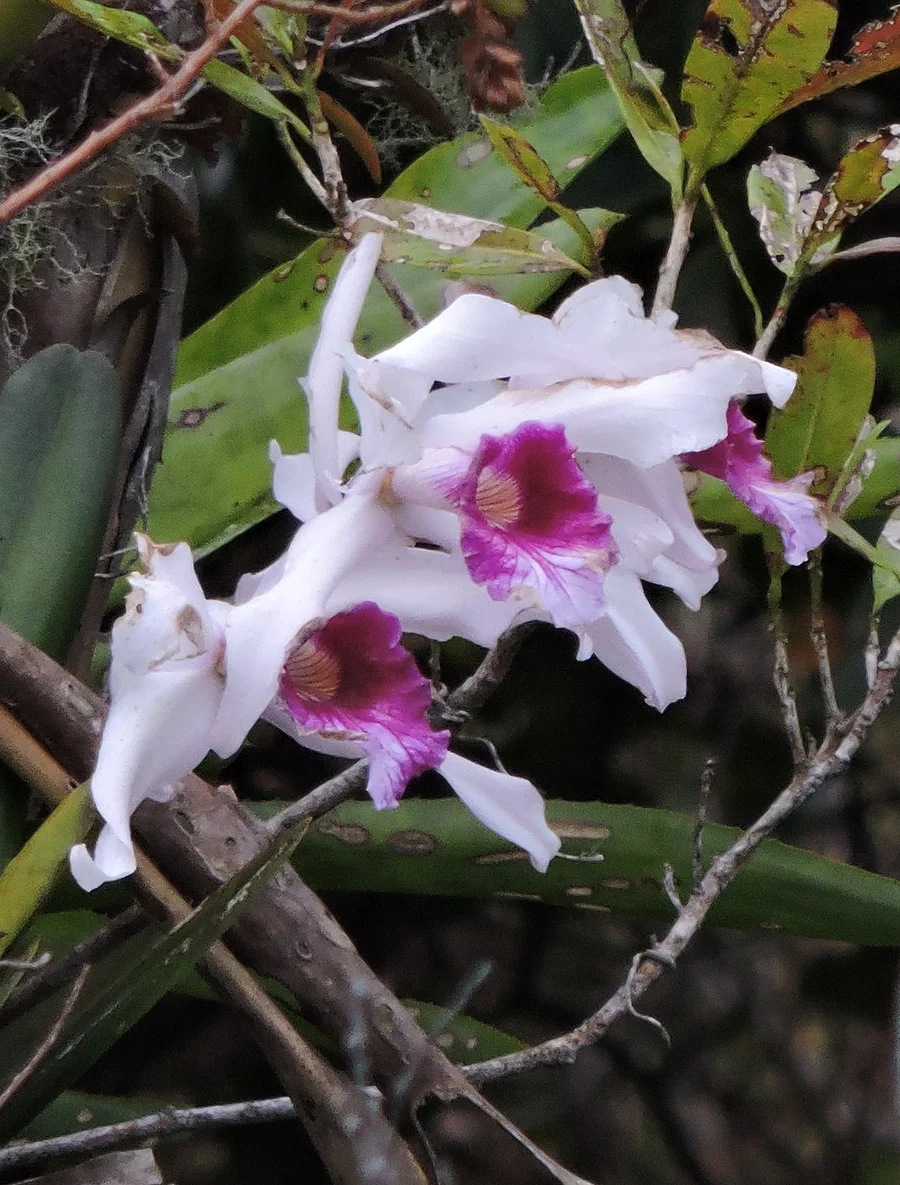
02 · Moisture content and temperature
Dry and cold, a seed lasts longer
Two things matter most in storage: the water inside the seed and the temperature. The seed exchanges moisture with the surrounding air, so the air where it is stored and the packaging come into play. The rule of thumb at the bench is to dry the seed before storing it and to store it cold. The table shows what the group saw, experiment by experiment.
| Seed | How it was stored | What was observed |
|---|---|---|
| Seven Cattleya species | Dried, for nine months, at room temperature, 5 °C and −18 °C, and in liquid nitrogen | They germinated well under all four conditions. Cattleya rupestris was the most resistant [4] |
| Eight Cattleya species | Dried, at −18 °C, in a conventional seed bank, for more than a decade | They kept germinating [6] |
| Three Cattleya species | Dried and stored for 270 days, from 5 °C to liquid nitrogen | Germination barely changed under most conditions. At −20 °C some species lost up to 46%, and liquid nitrogen proved to be a safe option [5] |
| Three Urochloa species | Spikelets at 20 °C, in dry or humid air, for up to 44 months | The heavier, well-formed spikelets were better preserved in dry air [8] |
The same condition does not suit all species, which is why each one needs its own test. A well-formed, well-dried seed already enters storage with an advantage: the seed lot that comes out of the harvest in good condition is the one that lasts.
03 · Dormancy
Storage also changes the seed
Freshly harvested forage grass seed is usually dormant: it is viable, but does not germinate. During storage, dormancy declines, and the seed lot germinates more. In Urochloa humidicola, storing the spikelets at 20 °C with slightly more moisture made dormancy decline earlier over the course of the year, without chemicals [7].
For the person reading the test, the consequence is direct: a seed that did not germinate may be dormant rather than non-viable. Germination alone does not tell the two apart. Tetrazolium does, because it stains living tissue even in a dormant seed [11].
04 · How it is checked
One sample at each withdrawal
Monitoring a stored seed lot means repeating the same tests on set dates. At each withdrawal, a sample is taken out of storage and goes to the germination test, under the conditions of the Brazilian Rules for Seed Testing [12], and to tetrazolium. The number from each date is compared with the one from the start.
The two tests together say more than either one alone. In stored Cattleya seeds, the group linked the tetrazolium result to the germination result [2]. For orchids, tetrazolium requires preconditioning in sucrose, without which viability comes out underestimated [9], and seeds with a thick or dark seed coat require bleaching [10]. For forage grasses, the tetrazolium method is described species by species in the ABRATES book on seed vigor [11].
Drying, storage and viability testing of orchid seeds and pollen are brought together, step by step, in a protocols chapter by the group [3].
05 · In SeedCounter
Each withdrawal becomes an image
In SeedCounter
Photograph or scan each replicate, at each withdrawal, with the ruler in the image. The app counts the seeds that germinated and those that did not, proposes viable and non-viable in tetrazolium, and leaves the decision to the person who checks. The Germination tab brings together the counts for each date and each treatment. The image stays as a record: you can reopen the session months later and check the seed that produced each number. The export comes out with one row per seed and the test report as a PDF.
Where it fails
The app counts and classifies what is in the image. It does not know whether a seed that did not germinate is dormant or non-viable: that is for tetrazolium or the laboratory protocol to say. And if the tetrazolium test on orchid seeds was run without preconditioning, the image already arrives with viability underestimated, and the app inherits the error.
The margin of each test report, which says how much of a difference between two dates can be just chance, is covered in The statistics of the test report. Reading the tetrazolium color is covered in Color and class.
References
The works behind this page
Almost all come from GPEOrq and GPSEM. The complete list, with what each one showed, is in Group publications.
- Machado Neto N.B., Custódio C.C. (2005). Orchid conservation through seed banking: ins and outs. Selbyana 26(1/2), 229–235. journals.flvc.org/selbyana
- Hosomi S.T., Custódio C.C., Seaton P.T., Marks T.R., Machado Neto N.B. (2012). Improved assessment of viability and germination of Cattleya (Orchidaceae) seeds following storage. In Vitro Cellular and Developmental Biology, Plant 48(1), 127–136. doi:10.1007/s11627-011-9404-1
- Seaton P.T., Hosomi S.T., Custódio C.C., Marks T.R., Machado-Neto N.B. (2018). Orchid seed and pollen: a toolkit for long-term storage, viability assessment and conservation. In Lee Y.-I., Yeung E.C.-T. (eds.), Orchid Propagation: From Laboratories to Greenhouses, 71–98. Humana Press. doi:10.1007/978-1-4939-7771-0_4
- Hengling M.M., Gianeti T.M.R., Hosomi S.T., Machado-Neto N.B., Custódio C.C. (2021). Storage of Brazilian Cattleya seeds from diverse biomes: lipid composition and effects on germination. Plant Biosystems 155(3), 487–497. doi:10.1080/11263504.2020.1762781
- Fileti J.F., Hengling M.M., Gianeti T.M.R., Pritchard H.W., Hosomi S.T., Machado-Neto N.B., Custódio C.C. (2021). Seed longevity and cryobiotechnology in the orchid genus Cattleya. CryoLetters 42(6), 353–365.
- Francisqueti A.M., Marin R.R., Hengling M.M., Hosomi S.T., Pritchard H.W., Custódio C.C., Machado-Neto N.B. (2024). Orchid seeds are not always short lived in a conventional seed bank! Annals of Botany 133(7), 941–952. doi:10.1093/aob/mcae021
- Abrantes F.L., Machado-Neto N.B., Custódio C.C. (2021). Seed moisture content can be used to accelerate dormancy release during after-ripening of Urochloa humidicola cv. Llanero spikelets. Ciência Rural 51(1), e20200526. doi:10.1590/0103-8478cr20200526
- Abrantes F.L., Machado-Neto N.B., Custódio C.C. (2025). Seed storage and germination of three grass species: effect of spikelet weight and dormancy. Brazilian Archives of Biology and Technology 68, e25241009. doi:10.1590/1678-4324-2025241009
- Hosomi S.T., Santos R.B., Custódio C.C., Seaton P.T., Marks T.R., Machado Neto N.B. (2011). Preconditioning Cattleya seeds to improve the efficacy of the tetrazolium test for viability. Seed Science and Technology 39(1), 178–189. doi:10.15258/sst.2011.39.1.15
- Custódio C.C., Marks T.R., Pritchard H.W., Hosomi S.T., Machado-Neto N.B. (2016). Improved tetrazolium viability testing in orchid seeds with a thick carapace (Dactylorhiza fuchsii) or dark seed coat (Vanda curvifolia). Seed Science and Technology 44(1), 177–188. doi:10.15258/sst.2016.44.1.17
- Custódio C.C., Aguiar R.P. (2020). Teste de tetrazólio em sementes de gramíneas forrageiras tropicais [Tetrazolium test in tropical forage grass seeds]. In Krzyzanowski F.C., Vieira R.D., França-Neto J.B., Marcos-Filho J. (eds.), Vigor de sementes: conceitos e testes [Seed vigor: concepts and tests], 2nd ed., ch. 15. ABRATES.
- Brasil, Ministério da Agricultura, Pecuária e Abastecimento (2009). Regras para Análise de Sementes [Rules for Seed Testing]. Brasília: MAPA/ACS.
Each withdrawal, one image.
Count germinated and viable seeds in SeedCounter and keep the image together with the number.