

It is the spot where the seed was attached to the mother plant by the funiculus. In black-eyed peas it becomes the black eye that gave Hilum its name.
Learn
From pixel to statistics, seed by seed.
Animations and tools for understanding what image-based seed analysis does under the hood. Use them to study, to teach a class, or just to satisfy your curiosity.
Animations
Twelve ideas, in motion
Each animation is a simulation drawn in code. The numbers in the panel are calculated right there, in your browser.
Explore
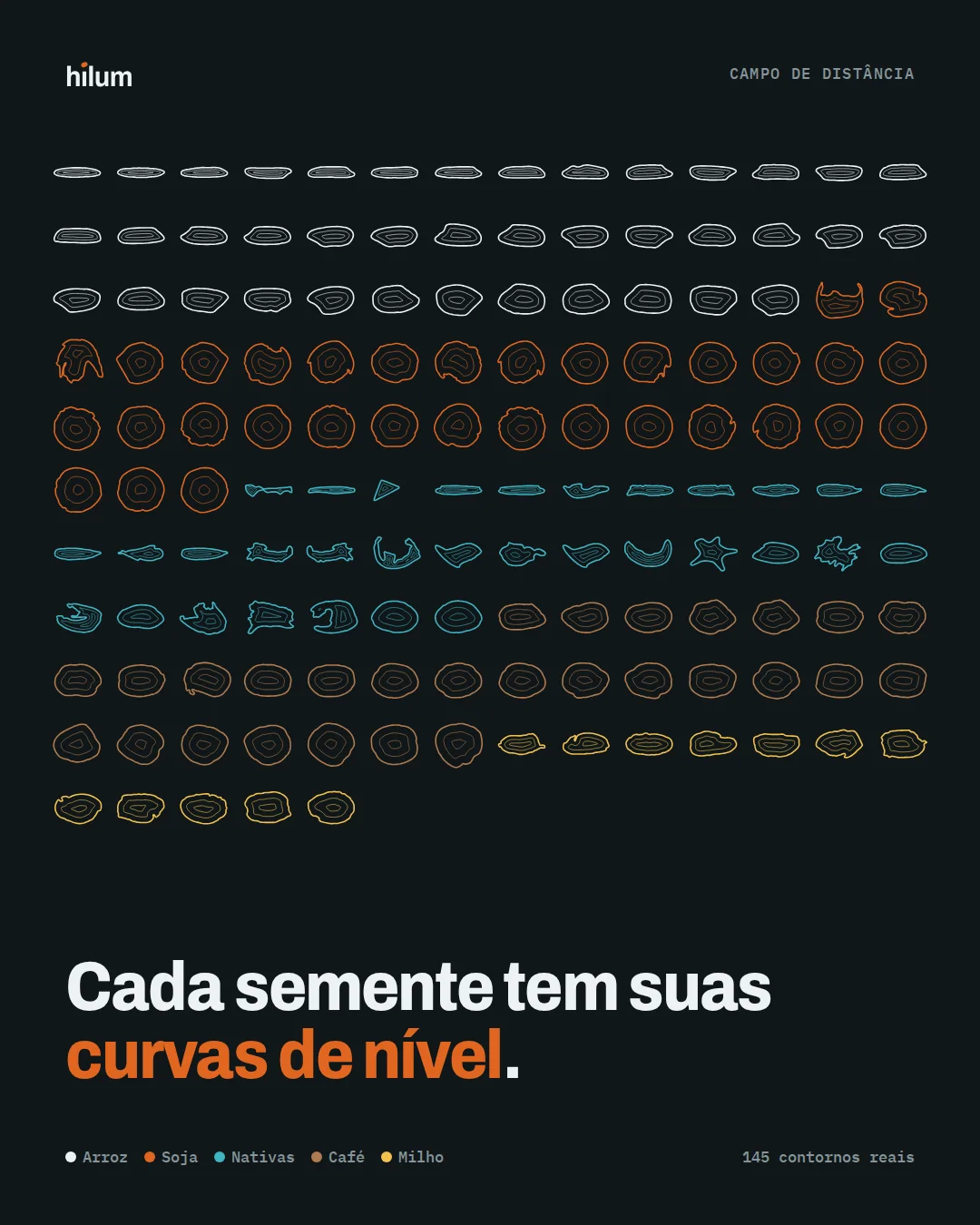
145 real seeds, from the inside
Silhouettes taken from SeedCounter's public examples: rice, soybean, coffee, corn and native species. The same calculations the app does, running right here.
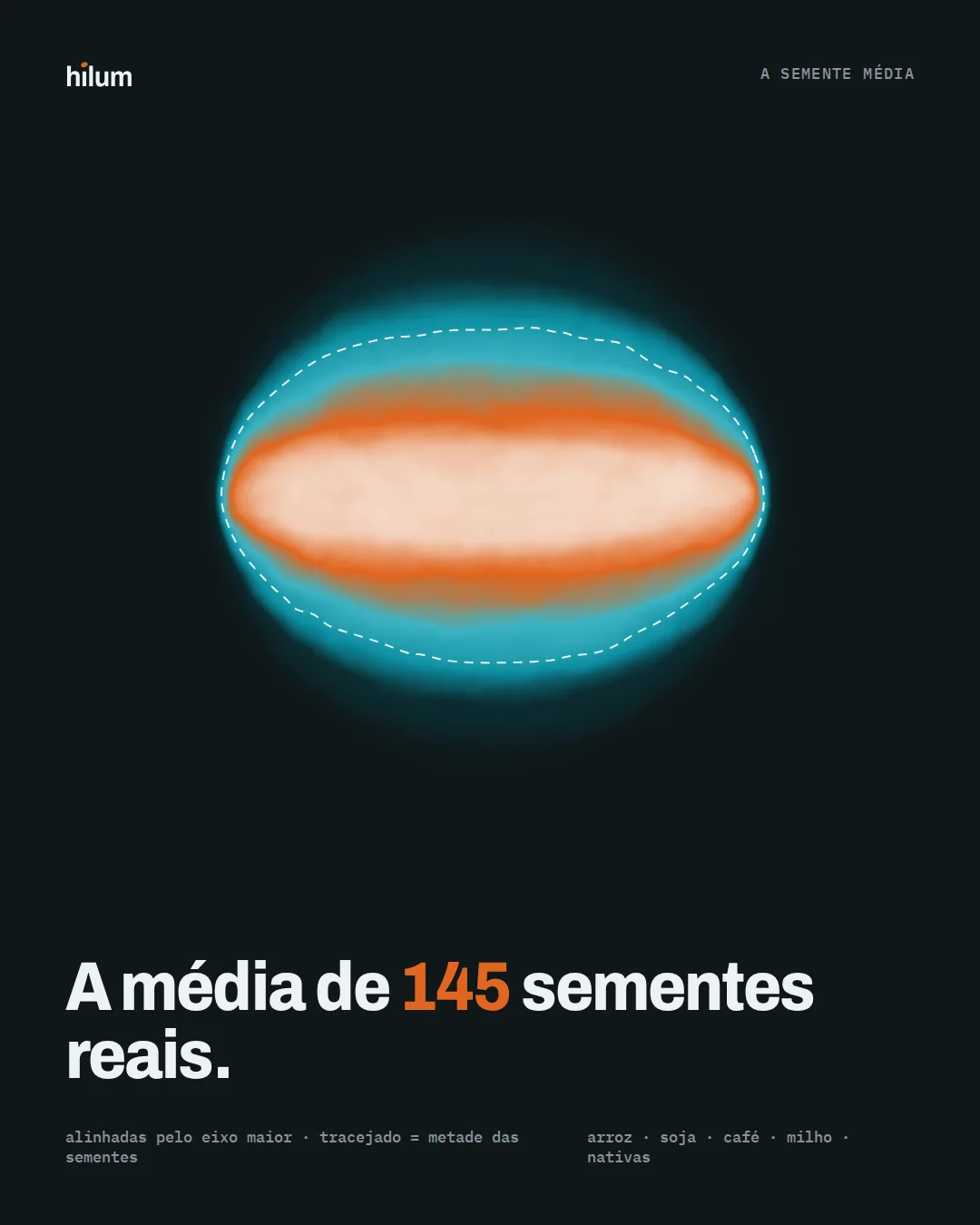
The mean seed shape
145seedsDistance field
–length / width
–maxima at the top
–reading
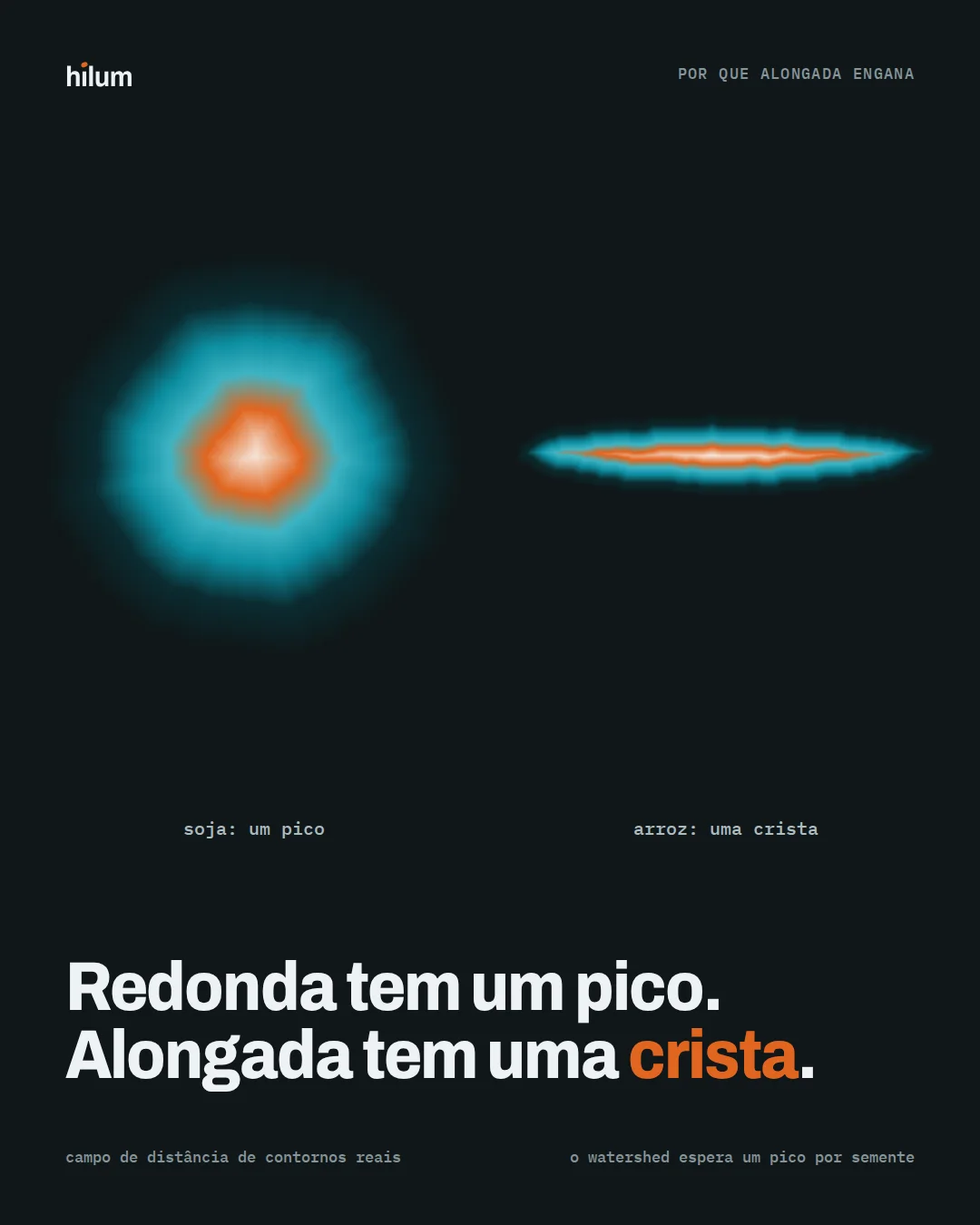
The brighter the pixel, the farther it is from the edge. A round seed has a single peak. An elongated seed turns into a ridge with several maxima, and a splitting algorithm can see two seeds where there is one.
Shape space
Each silhouette sits where the singular value decomposition put it. Nobody told the calculation which seed belongs to which crop, and they separate on their own. Hover over each one to see it.
Gallery
What the machine sees
Figures made from real data, with the source stated. Drag sideways.

Fun facts
Short facts, with measurements
About imaging and measurement. Fun facts about the seeds themselves, from the 2,000-year-old date palm to the Svalbard vault, are in Seeds.
Dehydrogenase enzymes in living tissue reduce the salt to formazan, which is red. The color is a record of respiration.
A human hair is 50 to 100 µm wide. On an APS-C camera with a 50 mm lens at 44 cm, that comes to 2 to 4 pixels. With extension tubes, 18 to 36.
An edge at 45° turns into a staircase, and adding up the pixel steps gives about 1.41 times the real length. That is why the perimeter needs a correction.
At 1:1 magnification and f/8, the depth of field is about 0.6 mm. A seed 1.4 mm tall does not fit entirely in focus, which is why focus stacking is used.
The threshold that separates seed from background comes from a paper by Nobuyuki Otsu: the cut that maximizes the variance between the two classes of the histogram.
The Feret diameter is named after L. R. Feret, who studied particle size in the 1930s. Shamos (1978) showed how to find it by rotating two calipers around the convex hull.
A yellow seed on blue paper: in the R − B channel one comes out positive and the other negative. Choosing the channel solves half the problem.
It equals 1 for a circle and drops as the shape elongates. A 2:1 ellipse gives about 0.84, and a signal grass (Urochloa) seed comes in near 0.8.
It has almost no reserves and, in nature, depends on fungi to germinate. Counting orchid seeds and running tetrazolium on them takes high magnification.
The Brazilian Rules for Seed Testing (RAS) use thousand-seed weight to convert mass to number. Counting from images checks that math.
Cattleya seeds dried and stored at −18 °C were still germinating after more than a decade in a conventional seed bank.
Now with your image.
Everything shown here runs in SeedCounter, on whatever photo you load.